


Selection Guidelines
Water-cooled cables are non-standard custom products. Customers need to provide accurate technical parameters when placing an order. The following are the key selection factors:
1. Conductor cross-sectional area (nominal cross-section, mm²)
This is the most critical parameter of a water-cooled cable, determining its current-carrying capacity. The cross-sectional area is selected based on the rated secondary-side current of the furnace transformer. The standard range covers from 25 mm² to 7000 mm². For electric arc furnaces, large cross-section cables are typically in the range of 2000 mm² to 8000 mm². Selection principle: cross-sectional area directly corresponds to current. Larger cross-section means higher current-carrying capacity, but also heavier cable and larger bending radius. The customer knows their transformer's secondary current value best, and converting that to the required cross-section is the most reliable approach.
2. Current-carrying capacity (rated current, A)
Closely related to cross-sectional area, this is the upper limit of current for long-term safe operation. After the customer provides the transformer's secondary-side rated current, the appropriate cross-sectional area can be recommended accordingly.
3. Length (m)
The length of a water-cooled cable depends on the actual installation distance between the water-cooled busbar and the self-conducting electrode arm on the furnace. Too long increases impedance and cost; too short may cause tensile stress and damage to the terminals. The most accurate method is to custom-manufacture the length based on the customer's installation drawings or on-site measurements.

4. Cooling water parameters
Water-cooled cables rely on internal circulating water to remove heat, so water pressure and flow rate are critical. Industry standards require that the outer hose withstand a working water pressure of at least 0.6 MPa, with high-quality products reaching above 0.8 MPa. Typical cooling water flow rates range from 5 to 15 liters per minute per cable, depending on the cross-sectional area.
5. Terminal type and water inlet/outlet positions
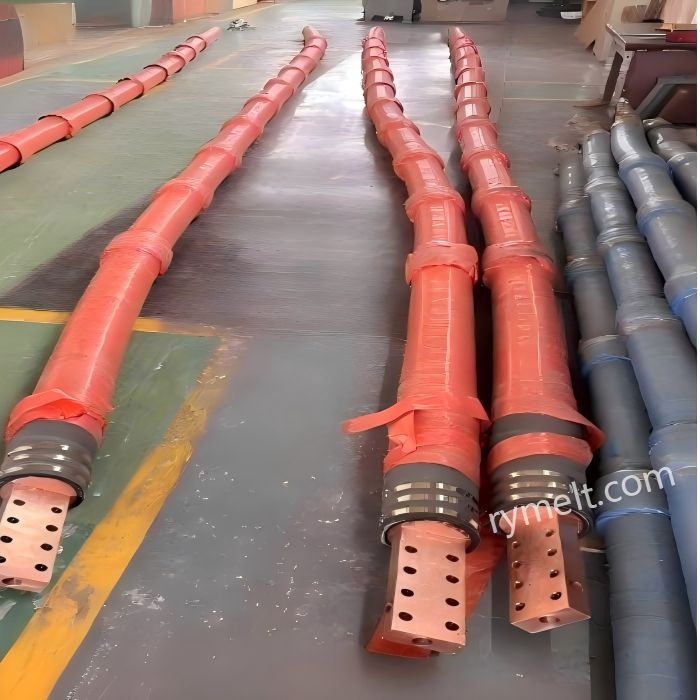
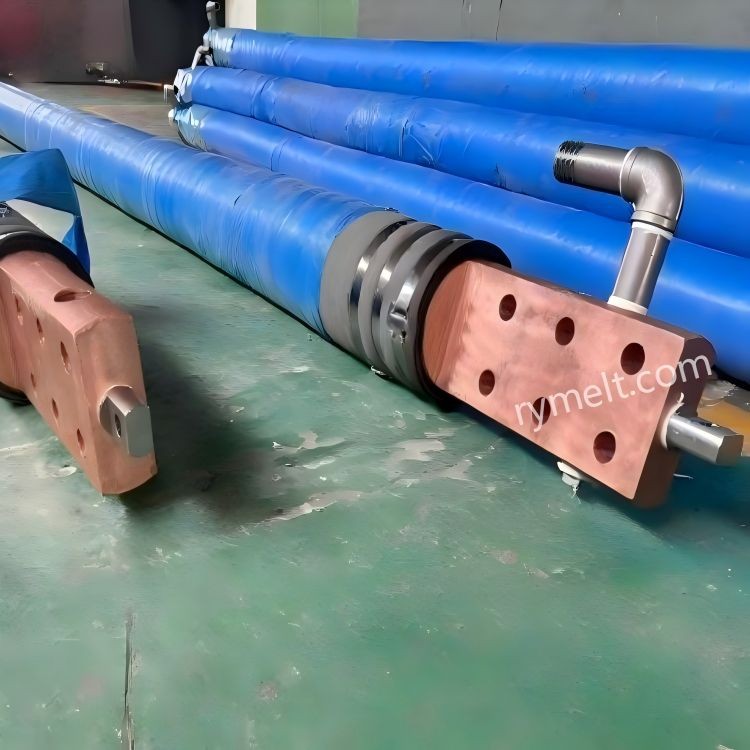
The terminals of a water-cooled cable come in various interface types that must match the customer's equipment. Common types include:
Flat flange type: connects to the equipment via a flange plate
Flared (bell mouth) type: uses a conical surface with a nut locking mechanism, large contact area, good sealing effect
Rotating terminal type: the interface can rotate, making on-site installation and angle adjustment easier
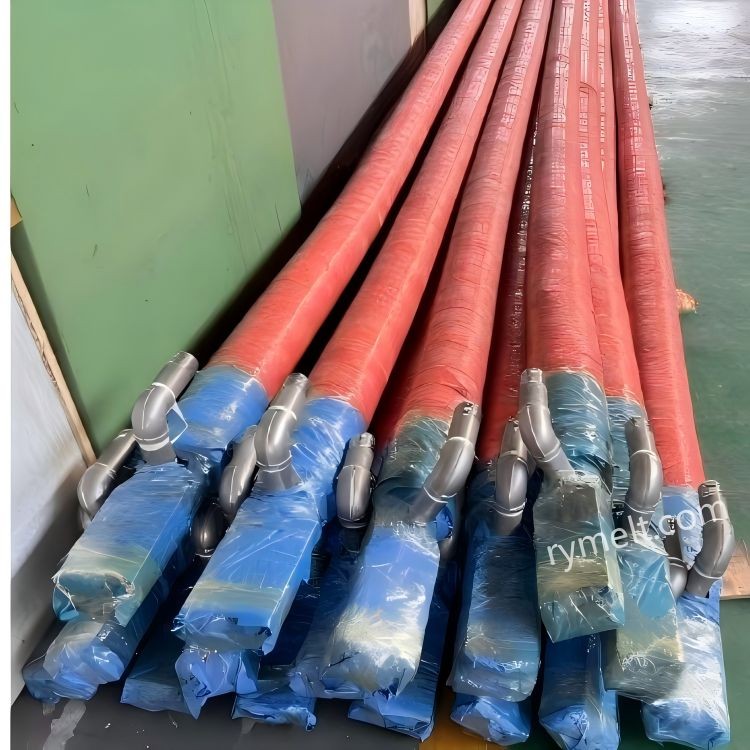
Water inlet/outlet positions: can be located on the side of the terminal, on the flange face, or on the end face of the terminal, to be determined according to the customer's equipment layout
6. Minimum bending radius (mm)
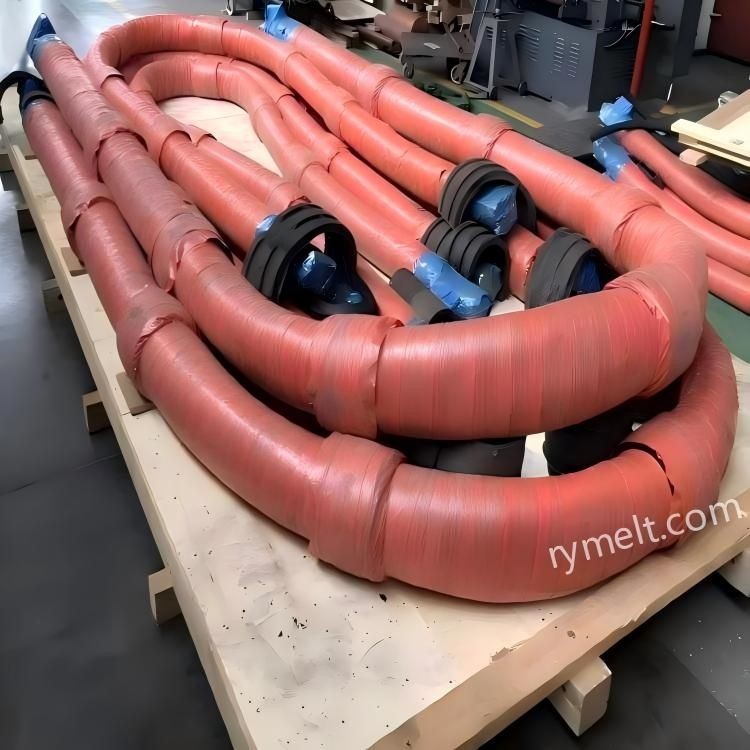
Water-cooled cables bend as the furnace tilts during operation. The bending must not exceed the cable's limit. The customer should provide the required bending radius based on the installation space, and the supplier will design accordingly. Too small a bending radius may damage the internal conductor or the outer hose.
7. Tensile strength requirements
Apart from conducting electricity and water, water-cooled cables also bear mechanical tension. Industry standards specify a test tension of 15 kN for a nominal cross-section of 200 mm², and for every additional 100 mm², the test tension increases by 5 kN.

Ordering Precautions (information the customer should provide when placing an order)
1. Provide complete basic technical data: furnace type and capacity (EAF/LF/submerged arc furnace, and the corresponding tonnage), transformer secondary-side rated current (determines cable cross-section), required total cable length (based on drawings or on-site measurement), equipment interface type (flange/flared/rotating type), water inlet/outlet position requirements (side/flange face/end face).
2. Specify conductor material and process requirements: conductor type (enameled wire is superior to bare copper wire, with a service life 1.5 to 2 times that of bare copper wire), surface treatment (tin plating enhances corrosion resistance and conductivity), clamp material (stainless steel or copper), terminal manufacturing process (requires no weld points, no contacts, one-piece forming).
3. Confirm cooling system parameters: maximum working water pressure requirement (typically not less than 0.6 MPa), cooling water flow rate requirement (matched to cross-section). Water-cooled cables must undergo a hydrostatic pressure test before leaving the factory, with a test standard of pressurizing to 1.3 to 1.5 times the working pressure and holding for 30 minutes with no leakage.

4. Confirm installation and interface details: before order confirmation, carefully check the interface drawings of both cable ends to ensure they match the dimensions of the on-site equipment flanges or connectors. Confirm the cable routing and fixing method on the equipment. If necessary, suggest that the customer provide a scrapped old cable as a sample; manufacturing according to an actual sample is the safest way to avoid specification errors.
5. Clarify delivery and acceptance standards: agree on delivery lead time (water-cooled cables are non-standard custom products, so a reasonable production period should be reserved), packaging requirements (moisture-proof, shock-proof, crush-proof), acceptance criteria (dimensional inspection, visual inspection, hydrostatic test report).
6. Consider spare parts strategy and warranty: water-cooled cables are among the fastest-wearing consumable parts in the short network system. It is recommended that customers keep at least one or two spare cables of each common specification in stock to handle sudden failures. Clarify the warranty period (typically 6 to 12 months) and the handling method during the warranty period.


