


Ordering Considerationsctions
To avoid selection errors and on-site installation problems, when ordering an electric arc furnace roof, the user should provide complete technical parameters to the supplier and confirm the following items:
1. Provide complete basic technical data
This includes the nominal tonnage of the electric furnace, furnace type (e.g., ultra-high power AC electric arc furnace), transformer rated capacity, electrode diameter and pitch circle diameter, outer diameter and height of the furnace roof, and estimated total weight of the furnace roof. Also specify the sealing type of the furnace roof (sand seal or knife-edge seal) and the required closing force.
2. Specify refractory material and installation requirements
For monolithic castable roofs, specify the material grades for the electrode delta region, the upper peripheral area, and the lower peripheral area (e.g., chrome-corundum, corundum, mullite).
Request the supplier to provide material physical and chemical property indices (bulk density, apparent porosity, cold crushing strength, high-temperature modulus of rupture, thermal shock stability, etc.) and third-party material test reports.
For brick-built roofs, confirm the brick shape drawings, the laying method, and the refractory mortar mix ratio.

3. Confirm cooling water system interfaces and parameters
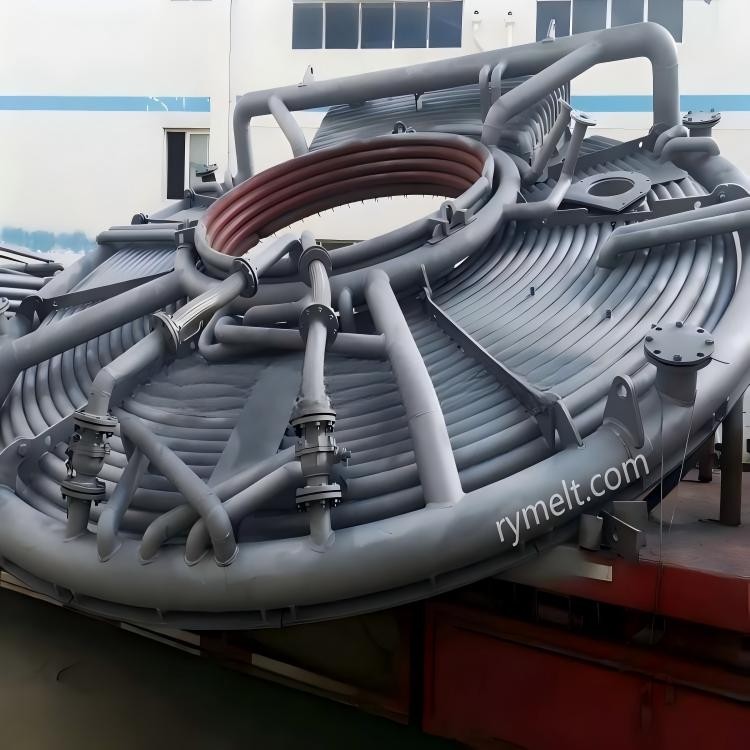
Provide the cooling water inlet and return pipe specifications (e.g., pipe diameter, flange standard or thread specification), and specify the maximum allowable working water pressure. Require the supplier to perform a hydrostatic test and provide a test report. The test pressure is generally 1.5 times the working pressure with a holding time of not less than 30 minutes to ensure no leakage.
4. Communicate mounting dimensions and suspension interfaces
Provide connection drawings of the electric arc furnace roof to the lifting and rotating mechanism, including the positions of the lifting lugs, hole diameters, pin dimensions, and hydraulic cylinder stroke. Confirm the gap design between the electrode hole sealing ring and the electrode (typically a single-side gap of 20 to 40 mm) to prevent the electrode from scraping against the roof.

5. Clarify delivery and acceptance terms
Delivery lead time: the time from order placement to shipment.
Packaging requirements: Refractory furnace roofs should be properly packed against moisture and shock.
Acceptance criteria: including dimensional inspection, visual inspection, hydrostatic test, material re-examination, etc.
On-site services: whether installation guidance or a recommended drying/firing curve is provided (monolithic castable roofs need to be baked according to a heating curve before first use).
6. Consider spare parts and after-sales warranty
It is recommended to order a complete set of spare electrode hole water-cooled sealing rings and to stock a small amount of repair castable. Specify the warranty period (typically 6 to 12 months or guaranteed number of heats) and the handling method for non-artificial damage during the warranty period (free repair or replacement).


